Zack Nachod
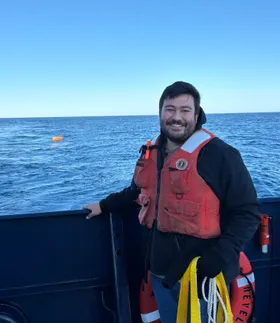
I’m a PhD candidate in the HI-CYCLES group at the University of Hawai’i at Mānoa. My work focuses on making biogeochemical Argo float observations more reliable and easier to use for studying the open ocean.
🎓 Google Scholar · iD ORCID · # GitHub · in LinkedIn · 📄 CV
Research
Section titled “Research”I work with autonomous ocean observations, especially Biogeochemical Argo floats, to improve data quality control and develop research-ready datasets for ocean biogeochemistry.
My current research contributes to BGC-Argo+, a quality-controlled global compilation of biogeochemical Argo float data with secondary quality control and derived parameters. I focus on identifying, quantifying, and correcting biases in biogeochemical Argo float observations, then developing those corrected measurements into a new dataset for broader scientific use.
I also build tools for working with large float datasets. One current project is an outlier-removal interface for Argo float data that lets users move through floats and profiles, manually flag suspect data, and export those decisions for downstream quality-control workflows.
I am especially interested in how improved float data products can support studies of open-ocean carbon, oxygen, pH, nitrate, and related biogeochemical variability. In future work, I plan to pair satellite and float observations to explore ocean greening, investigating whether observed changes in surface phytoplankton bloom phenology and magnitude reflect broader biogeochemical changes in the upper ocean and biological carbon export.
Background
Section titled “Background”I am based in the Department of Oceanography at UH Mānoa, where I work with the HI-Cycles group on ocean observing, data quality, and open-ocean biogeochemistry. My day-to-day work is a mix of float data analysis and collaborative projects that use BGC-Argo observations at regional to global scales.
During my undergraduate studies, I worked with CMIP climate models to investigate differences in Pacific water-column stratification. I also used machine learning models trained with biogeochemical Argo float data to predict biogeochemical properties along Seaglider tracks in the Southern Ocean.
Alongside that research, I worked as a float technician in the University of Washington Argo Float Lab from 2020 to 2022. There, I helped assemble, calibrate, bench test, and quality-control core and biogeochemical floats before deployment. I also supported instrument inventory and shipping, entered and checked technical data for quality control, used Python to analyze float data and diagnose failure modes, and helped train new hires in float assembly, maintenance, and data workflows.
Education
Section titled “Education”- PhD Candidate, Marine Geology and Geochemistry, University of Hawai’i at Mānoa. Concentrations: chemical oceanography, data science/programming, and ocean technology.
- BS, Oceanography, University of Washington. Minors: Arctic studies, applied mathematics, and data science.
Fieldwork and Service
Section titled “Fieldwork and Service”I have worked at sea on the A16S 2026 cruise aboard the R/V Revelle, HOT Cruise #356 aboard the R/V Sikuliaq, and the 2021 VISIONS cruise aboard the R/V Thompson. These experiences complement my work with autonomous observing systems by connecting float data products back to shipboard sampling, instrument deployment, and oceanographic field operations.
I am a Uehiro Center for the Advancement of Oceanography Fellow and have been involved in graduate student service through Nā Kama Kai. I have also supported teaching and outreach through participating in panels for undergraduate oceanography courses, lab tours, SOEST events, the Orca Bowl, and public science events.
Selected Presentations
Section titled “Selected Presentations”- Nachod, Z., Bushinsky S. M., Jutras M., König D., McClish S., Addey C., Tamsitt V., Williams N., Fassbender A. J. BGC-Argo+: Global biogeochemical Argo float data with secondary quality control, derived parameters, outlier removal, and bias adjustment. Poster given at the Southern Ocean Carbon and Climate Observations and Modeling Annual Meeting, San Diego, CA. 2026.
- Nachod, Z., Bushinsky S. M., Tamsitt V., Williams N., Fassbender A. J. Development of an adjusted biogeochemical Argo float oxygen dataset to address observed biases in relation with shipboard data. Poster given at Ocean Sciences Meeting, Glasgow, Scotland. 2026.
- Nachod, Z., Gray, A. R. Evaluation of machine learning techniques for estimating biogeochemical properties on Seaglider tracks in the Southern Ocean. Poster given at the University of Washington Undergraduate Research Symposium, Seattle, WA. 2022.
Publications
Section titled “Publications”Selected publications and manuscripts:
Bushinsky, S. M., Nachod, Z.*, Jutras†, M., König†, D., McClish*, S., & Addey*, C. BGC-Argo+: Global biogeochemical Argo float data with secondary quality control and derived parameters. Submitted.
Jutras†, M., Bushinsky, S. M., Cerovečki, I., Nachod, Z.*, & Hawco, N. Widespread increase of nitrate in subsurface waters over recent decades revealed by observations. ESS Open Archive, 2026(0213). https://doi.org/10.22541/essoar.177100488.81138870/v1
Bushinsky, S. M., Z. Nachod*, A. J. Fassbender, V. M. Tamsitt, Y. Takeshita, and N. Williams (2025). Offset between profiling float and shipboard oxygen observations at depth imparts bias on float pH and derived pCO2. Global Biogeochemical Cycles, 39(5). https://doi.org/10.1029/2024GB008185
Song, S., Lavin, P. D., Gray, A. R., Nachod, Z., et al. Random forest regression using autonomous in situ ocean observations: Inferring small-scale nutrient variability during a Southern Ocean field experiment. ESS Open Archive. https://doi.org/10.22541/essoar.171707849.91867565/v2